

The best solar power bank combines monocrystalline silicon cells with enough panel wattage to charge smartphones and GPS receivers before sundown. But which actually works? Below, we rank six foldable solar panels and integrated solar power banks by direct and indirect sun charging performance.
PowerOutage.us tracks 950 utilities serving more than 200 million customers and sends real-time alerts when outages affect a specific area. That coverage can help you decide if a foldable monocrystalline solar power bank is enough or if a home battery backup is a better option.
6 Best solar power banks in 2026
We match each panel power bank below to a specific use case based on wattage class, measured output efficiency, and portability, covering the full spectrum from ultralight backpacking to base camp power station recharging.
Note that most options on this list are actually foldable solar panel arrays that can plug into separate banks, not integrated battery-panel options. Most integrated options provide very little charging power typically, and aren’t reliable options if you need to depend on portable power.
1. BigBlue SolarPowa 28
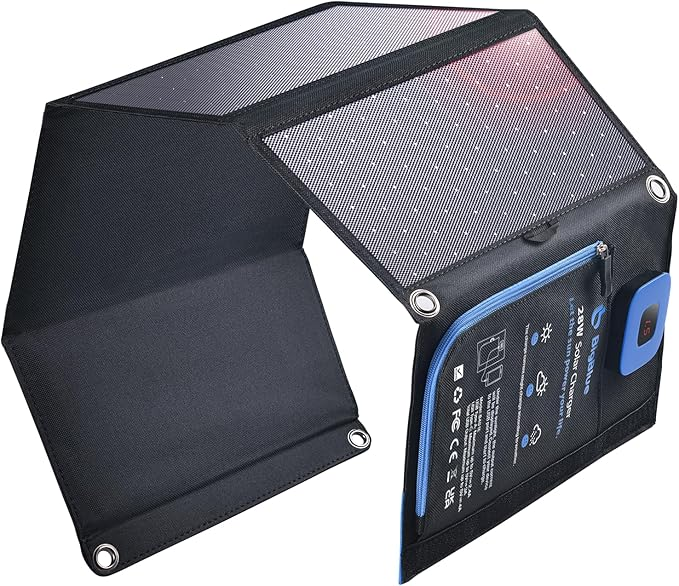
The BigBlue SolarPowa 28 generates more milliamp-hours per dollar than any larger panel in its wattage class. It delivers consistent output in direct and indirect sun while folding to approximately paperback-novel size at 20.9 oz. It’s great for campers, backpackers, and emergency kit builders who need reliable output in both clear and overcast conditions without committing to a heavy base camp setup.
What are the BigBlue SolarPowa 28's key features?
The BigBlue SolarPowa 28's specifications explain why it generates more milliamp-hours per dollar than any larger panel in its wattage class.
- 28W monocrystalline silicon output across four foldable photovoltaic panels
- Three USB output ports: one USB-A and two USB-C for simultaneous multi-device charging
- Storage pocket for charging cables, a compact lithium power bank, and accessories
- Carabiner-compatible attachment points for hanging on tent poles, tree branches, or bike frames
- IPX4 weatherproofing protects against water splashes and light rain
- Velcro closure keeps panels neatly bundled during pack transport
What are the pros and cons of the BigBlue SolarPowa 28?
The SolarPowa 28 leads this roundup in direct sun efficiency and value, but its lack of a kickstand and limited weatherproofing are where it falls short.
Pros
- Highest direct-sun output of any panel under 30 watts
- Three USB outputs allow simultaneous charging of a smartphone, GPS receiver, and emergency radio
- Lightest 20-plus-watt panel with a weight of 20.9 oz, so it fits in most daypacks and trail pack hip belt pockets
- Affordable price relative to larger panels that produce lower output per watt
Cons
- No kickstand legs means it requires a rock, pack, or carabiner to angle the panel toward the sun
- IPX4 rating offers minimal protection (not good for heavy rain or submersion)
- Indirect sun output (583 mAh/hr) falls well below the SunJack 25W in overcast conditions
2. SunJack 25W
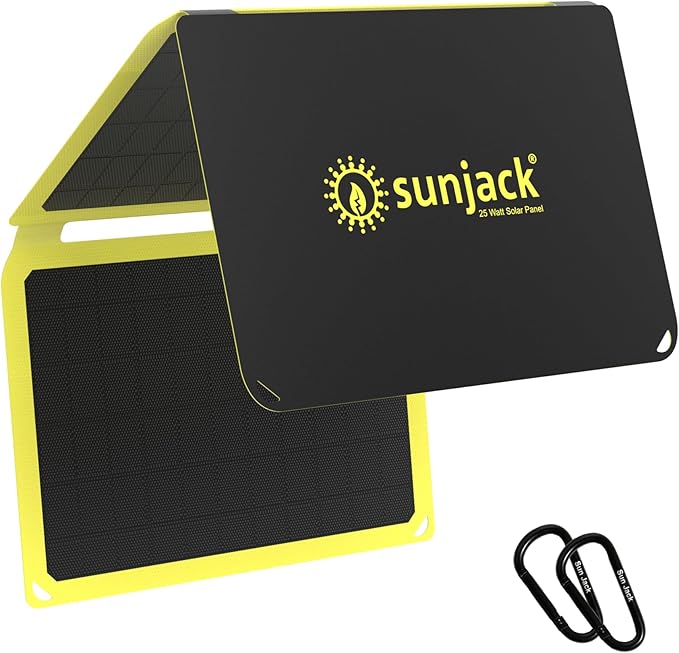
The SunJack 25W leads all panels in indirect sun output at 675 mAh per hour. Its zippered accessory compartment stores a 10,000mAh lithium power bank and charging cables in one compact package. This solar charger is great for hikers and emergency preparedness households in marine-layer or frequently overcast regions where charging must continue through cloud cover.
What are the SunJack 25W's key features?
The SunJack 25W outperforms panels with double the wattage in overcast conditions, making indirect sun output the defining reason to choose it over lighter alternatives.
- 25W monocrystalline silicon output in a three-panel foldable configuration
- 675 mAh per hour in indirect sun, the highest on our list
- Zippered cable and battery compartment holds a 10,000mAh power bank during transport
- Folds and unfolds quickly with no magnets, snaps, or clasps
What are the pros and cons of the SunJack 25W?
The SunJack 25W delivers the strongest overcast performance, though its weight and price are higher than the BigBlue SolarPowa 28 for comparable output in direct sun.
Pros
- Best indirect sun output
- Durable, weather-resistant construction handles prolonged outdoor use
- Zippered compartment solves cable organization without extra accessories
- Available with two 10,000mAh lithium battery banks as a bundled system
Cons
- Heavier than the BigBlue SolarPowa 28 at 29.4 oz
- Stiffer, ridged construction makes it harder to roll or compress into a full pack
- Higher list price than most 25W alternatives at approximately $120
3. Goal Zero Nomad 50
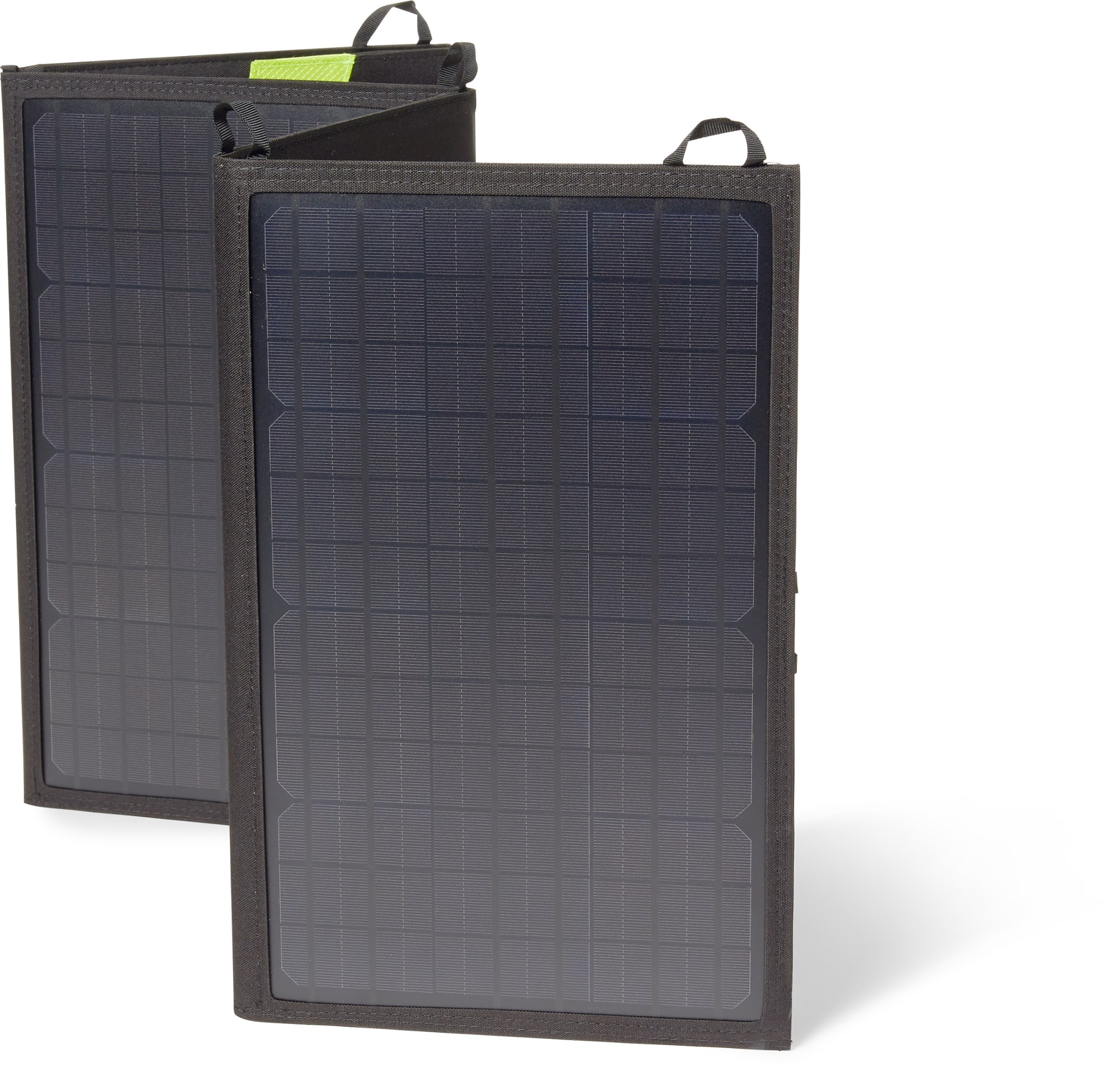
The Goal Zero Nomad 50 is a 50W monocrystalline panel producing strong indirect sun output and accepting DC connections for portable power station charging. Its built-in kickstand and chainable connectors make it the standard for stationary charging setups. This emergency solar power bank is great for car campers, overland vehicles, and base camp setups where maximum sustained output is important.
What are the Goal Zero Nomad 50's key features?
The Goal Zero Nomad 50's specifications reflect a base camp and power station recharging system, with a DC output port and chainable connector that no other panel in this roundup offers.
- 50W monocrystalline output across a large six-panel foldable array
- DC output port for direct connection to Goal Zero Yeti 3000X, Yeti PRO 4000, and compatible power stations
- USB-A and USB-C output ports for direct device charging alongside a DC power station input
- Designed for integration into the Goal Zero ecosystem of portable power stations and home backup batteries
What are the pros and cons of the Goal Zero Nomad 50?
The Nomad 50 covers base camp and overland scenarios that smaller panels cannot handle, but its weight of nearly 7 lbs makes it unsuitable for any backpacking or emergency go-bag application.
Pros
- The largest photovoltaic surface area in this roundup enables strong overcast output (622 mAh/hr)
- DC output allows faster recharging of Goal Zero Yeti power stations than USB input alone
- Built-in kickstand simplifies sun angle optimization, especially in early morning and evening hours
- Chainable parallel design enables scalable base camp arrays without additional adapters
Cons
- Heaviest panel in this roundup by a wide margin at 110.4 oz (nearly 7 lbs); impractical for backpacking
- Lower milliamp-hours per watt in direct sun than smaller 25-28W panels at comparable price points
- High list price (about $250) is difficult to justify compared to the BigBlue or SunJack for lighter use cases
4. Jackery SolarSaga 100W
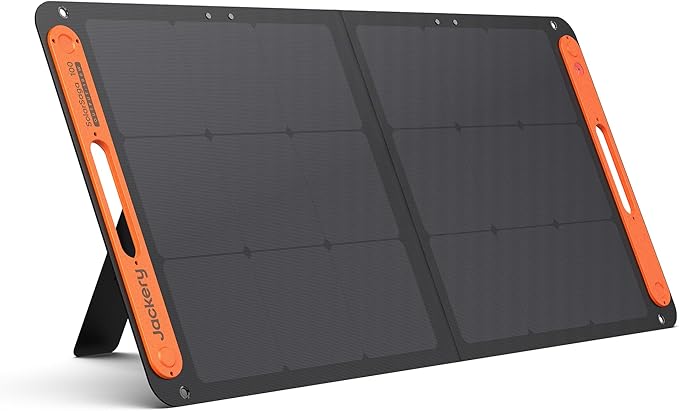
The Jackery SolarSaga 100W is a 100W ETFE-laminated monocrystalline panel designed for direct connection to Jackery Explorer power stations. Its IP68 weatherproofing and laminated cell coating make it the most durable panel in this roundup for wet outdoor environments. This battery is great for Jackery Explorer power station owners who need a weather-resistant high-output panel for easy integration.
What are the Jackery SolarSaga 100W's key features?
The Jackery SolarSaga 100W's specifications prioritize deep integration with Jackery Explorer portable power stations, with an IP68 weatherproof rating and ETFE-laminated cells that set it apart from every other panel in this roundup.
- 100W monocrystalline silicon output via ETFE-laminated photovoltaic cells for long-term efficiency retention
- USB-C and USB-A output ports for direct device charging alongside a power station input
- Plug-and-play compatibility with Jackery Explorer 1000 v2, Explorer 1000 Pro, and Explorer 2000 Plus
- Magnetic closure and carry handle for compact storage and field setup
What are the pros and cons of the Jackery SolarSaga 100W?
The SolarSaga 100W is the strongest choice for fast recharging of a Jackery Explorer power station, but its price and weight are difficult to justify for USB-only device charging.
Pros
- 100W rated output recharges a Jackery Explorer 1000 v2 significantly faster than any 28W panel
- IP68 weatherproofing exceeds the IPX4 rating of every other panel in this roundup
- ETFE lamination makes the panel more durable and longer-lasting in sustained outdoor exposure
- Direct plug-and-play connection with Jackery Explorer power stations requires no adapters or conversion cables
Cons
- Comparable smartphone charging times to smaller 28W panels despite the higher wattage rating
- Higher price and greater weight make it impractical for ultralight backpacking or casual emergency use
- Best value only when paired with a Jackery Explorer power station
5. Blavor 10W
The Blavor 10W generates 1,401 mAh per hour in direct sun, surpassing several 30W panels in per-watt efficiency. At 12.6 oz with carabiner clips and a velcro battery pouch, it attaches to any trail pack for on-trail charging. This solar bank is best for ultralight backpackers and day hikers who need a lightweight solar charger for emergency smartphone and GPS receiver charging on trips under five days.
What are the Blavor 10W's key features?
The Blavor 10W's specifications show how a 10-watt monocrystalline panel achieves per-watt efficiency that matches or exceeds several 30-watt panels when cell quality is prioritized over panel count.
- 10W monocrystalline silicon output in a compact four-panel foldable configuration
- 1,401 mAh per hour in direct sun, high per-watt output for a 10W panel
- One USB-A and one USB-C output for simultaneous device and power bank charging
- Integrated velcro sleeve holds a 10,000mAh lithium power bank flat against the panel face
- Carabiner attachment points for clipping to daypack straps, tent guylines, or branch hooks
- Thin when folded; fits in a hip belt pocket or hydration sleeve without rearranging gear
What are the pros and cons of the Blavor 10W?
The Blavor 10W delivers the best efficiency-to-price ratio of any lightweight panel in this roundup, though its 10-watt ceiling limits simultaneous multi-device charging.
Pros
- Best per-watt conversion efficiency of any 10W panel
- Lowest price in this roundup at approximately $40
- Velcro power bank sleeve eliminates cable clutter and keeps the system organized on a pack
- At 12.6 oz, it’s light enough to include in an ultralight backpacking kit
Cons
- A 10W output can’t simultaneously charge a smartphone and a GPS receiver at full speed
- No IP or IPX weatherization rating; prolonged rain exposure risks USB port damage
- Indirect sun output (295 mAh/hr) is low; not reliable for overcast coastal or Pacific Northwest conditions
6. BioLite SolarPanel 5+
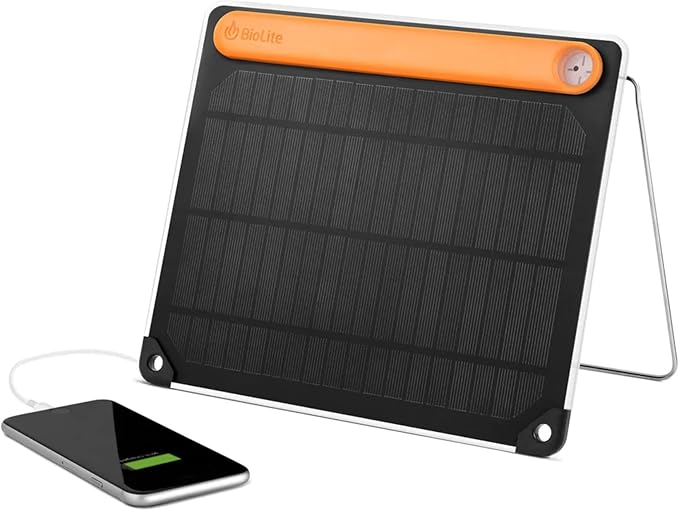
The BioLite SolarPanel 5+ packs a 3,200mAh lithium battery into a 5W monocrystalline panel at 13.4 oz. Its kickstand and integrated sundial simplify sun angle optimization. It is the only panel in this roundup that functions as a standalone power source without a separate battery pack. It’s awesome for rail runners, ultralight hikers, and emergency go-bag builders who want a single self-contained unit that stores solar energy for after-dark charging without carrying a separate battery pack.
What are the BioLite SolarPanel 5+'s key features?
The BioLite SolarPanel 5+ stores solar energy internally for after-dark discharge, which distinguishes it from every other option in the group.
- Integrated kickstand for direct sun angle adjustment without propping against external objects
- Sundial indicator built into the panel face to identify optimal alignment with the sun position
- USB-A output for charging smartphones, GPS receivers, and headlamps
- Self-contained form factor eliminates the need for a separate lithium power bank on ultralight trips
- Weighs 13.4 oz; smaller than the BioLite's own packaging when set up and deployed
What are the pros and cons of the BioLite SolarPanel 5+?
The SolarPanel 5+ is the smallest integrated package available, but its 5-watt output and limited battery capacity position it as a trail companion rather than a primary emergency backup device.
Pros
- 3,200mAh integrated battery stores solar energy for nighttime device charging without additional hardware
- Smallest and lightest integrated solar power bank in this roundup
- Practical for trail running vests, minimalist go-bags, and short emergency kit applications
Cons
- 5W panel output generates only 543 mAh/hr in direct sun; a full smartphone recharge takes 4 or more hours
- The integrated battery must charge before USB output becomes available; connecting a device to a depleted unit produces no charge
- Water resistance is undisclosed
- 3,200mAh battery capacity falls below most modern smartphone battery sizes (typically 4,000 to 5,000mAh)
What should you look for in a solar power bank?
Choosing the right solar power bank comes down to two numbers: panel wattage and panel weight. A high-watt panel recharges devices faster but weighs more. To choose the right one, decide on your power and trail durability needs.
What wattage solar panel do you actually need?
Panel wattage determines charging speed, and the right wattage depends entirely on the devices you plan to charge.
- Smartphones (3,000 to 5,000mAh battery): A 10 to 15W monocrystalline panel recharges a typical Android flagship or iPhone in 4 to 6 hours of direct sun
- GPS receivers and satellite communicators: 10 to 25W is sufficient for daily top-off charging
- USB-C laptops: 65 to 100W panels are required since 28W panels cannot sustain most laptop charging rates
- Portable power stations (Jackery Explorer 1000 v2, Goal Zero Yeti 3000X): 100W or more is needed for meaningful recharging speed
For emergency smartphone and handheld radio charging, a 25 to 28W monocrystalline panel covers most use cases. Anything above 50W makes more sense as a power station input than as a hiking solar charger. For a broader view of solar battery storage system costs, our separate guide covers full home system pricing.
A useful efficiency benchmark: divide the direct-sun mAh output by the panel's wattage. The BigBlue SolarPowa 28 produces 77.8 mAh per watt per hour (2,177 divided by 28), while the Goal Zero Nomad 50 produces only 32.4 mAh per watt per hour (1,619 divided by 50). Smaller panels often win on efficiency per watt, even though they lose on raw output.
What does an IP rating mean for a foldable solar panel?
An IP (Ingress Protection) rating quantifies a panel's resistance to solid particle and liquid penetration. For a foldable solar panel used outdoors, it is the most reliable indicator of weather durability.
- IPX4: Protected against water splashes from any direction (adequate for trail use and light rain)
- IP65: Protected against dust and low-pressure water jets
- IP68: Protected against continuous submersion (Jackery SolarSaga standard; strongest available in this category)
- No IP rating listed: Water resistance is unknown, so treat the panel as splash-sensitive near USB ports
The BigBlue SolarPowa 28 and SunJack 25W both carry IPX4 ratings, which handle typical field use. If the panel will be used near rivers, in coastal rain, or during multi-day trips with unpredictable weather, the Jackery SolarSaga 100W's IP68 rating is the safer choice.
How long does a solar panel take to fully charge 10,000mAh?
Charging time depends on panel wattage, sun intensity, panel angle, and cable losses. The following estimates assume peak-hour direct sunlight at an optimal angle, charging a 10,000mAh power bank.
- 5W panel (BioLite SolarPanel 5+): 20 or more hours
- 10W panel (Blavor 10W): 10 to 12 hours
- 25 to 28W panel (SunJack 25W, BigBlue SolarPowa 28): 5 to 6 hours
- 50W panel (Goal Zero Nomad 50): 5 to 7 hours (larger panels do not scale linearly)
- 100W panel (Jackery SolarSaga 100W): 2 to 4 hours
A 10,000mAh lithium power bank stores approximately 37Wh of usable energy. At 28W input with a 90% charging efficiency factor, that is about 1.5 hours theoretically. Real-world charging takes longer because USB charging controllers limit input current and panels rarely sustain their full rated output.
Budget for the 28W panel to fill a 10,000mAh power bank in 4 to 6 hours of direct midday sun. On a partly cloudy day, plan for 8 to 10 hours.
Does monocrystalline panel temperature affect charging speed?
Photovoltaic cells lose efficiency as surface temperature rises, according to National Laboratory of the Rockies data. The standard temperature coefficient for monocrystalline panels is approximately negative 0.4% per degree Celsius above 25°C (77°F). On a hot summer day with the panel lying on dark pavement, surface temperature can exceed 60°C, reducing output by up to 14%.
Can a solar power bank keep you connected during a power outage?
For smartphones and emergency communication devices, yes. For backing up refrigerators and appliances requiring AC power, no. That requires a reliable home battery backup instead.
A 28W foldable monocrystalline panel with a 20,000mAh lithium power bank sustains smartphone charging indefinitely in a sunny region. A modern smartphone consumes approximately 5 to 15Wh per day under typical use. A 20,000mAh power bank stores roughly 74Wh of usable energy.
If your area receives 5 peak sun hours per day, the BigBlue SolarPowa 28 generates enough energy to keep two smartphones charged continuously without the power bank fully depleting.
For appliances drawing more than 100W of sustained power, a portable power station paired with the Jackery SolarSaga 100W or Goal Zero Nomad 50 is the minimum practical setup. Our battery backup without solar guide covers standalone units for high-draw loads.
Real-world outages where solar charging kept communication devices running
Outage events like public safety power shutoffs and windstorms show why a foldable power bank can be indispensable.
Southern California Edison and LADWP proactively de-energized 166,737 additional customers during the Los Angeles wildfires in January 2025 through Public Safety Power Shutoffs. With grid power deliberately cut to prevent ignition, foldable monocrystalline solar panels offered the only charging option for smartphones and emergency radios during evacuation.
Similarly, a derecho crossing 770 miles in 14 hours knocked out power to 1.2 million customers across Illinois, Iowa, and Indiana in August 2020. PowerOutage.us tracked 440,000 customers without power at its peak. After the storm passed, clear skies allowed solar panels to recharge lithium power banks during the multi-day outage.
Quick recap
Overall, the BigBlue SolarPowa 28 handles most emergency preparedness and camping solar charging needs at the best balance of output, weight, and price. The SunJack 25W leads in overcast conditions. For ultralight kits, the Blavor 10W provides the best value per ounce. Pair any panel above 20 watts with a separate 10,000mAh lithium power bank for reliable multi-day charging.