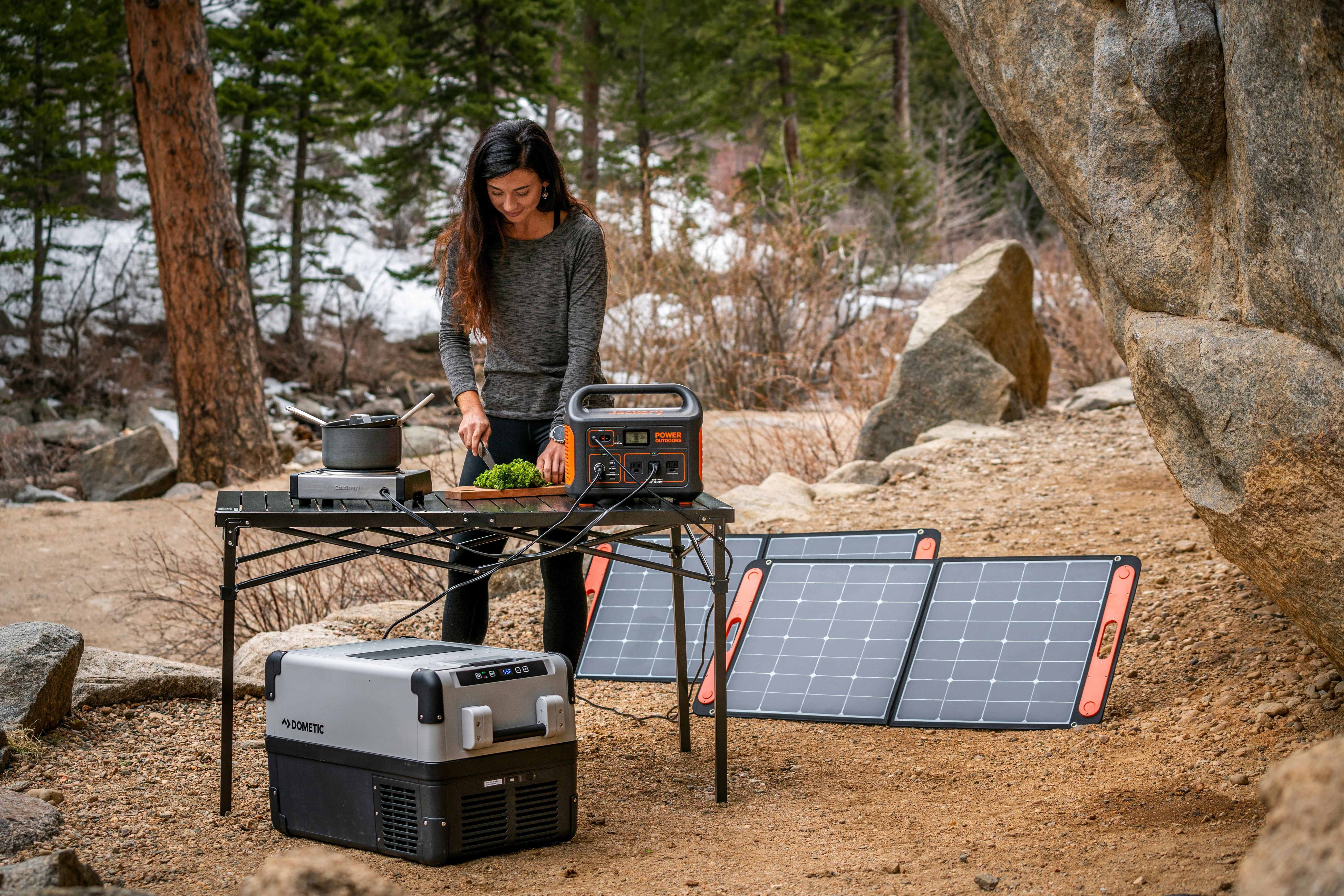


An off-grid solar system powers a home, cabin, or RV with solar panels and batteries alone, with no connection to the utility grid. This guide covers every component the setup requires, the situations where off-grid solar technology makes sense, and the limits that push most homeowners toward a grid-tied system instead.
PowerOutage.us has tracked every major US outage since 2016 across 950 plus utilities. That outage record grounds our off-grid guidance, so you size a system that carries your home through cloudy weeks instead of finding its limits in the dark.
What is an off-grid solar system?
An off-grid solar energy system generates, stores, and delivers power without the public electricity grid. Solar panels produce the electricity and batteries store it for use at night and through low-sunlight stretches.
Off-grid systems power remote homes, RVs, cabins, and any site beyond utility reach. A properly sized setup eliminates utility bills and utility dependence in one move.
What's the difference between on-grid and off-grid PV systems?
On-grid photovoltaic systems exchange power with the public grid, while off-grid systems run entirely on their own solar panels and battery storage.
Off-grid setups actually require fewer components. Because no power flows between the system and a utility, off-grid systems skip the grid-interactive equipment that manages that exchange.
Here are a few key differences between on-grid and off-grid solar systems:
| Aspect | On-Grid Systems | Off-Grid Systems |
|---|---|---|
| Grid connection | Connected to public grid | Completely independent |
| Energy storage | Optional | Battery storage essential for using power later |
| Backup power | Provided by the grid | Requires generator or additional storage |
| Ideal scenarios | Urban and suburban homes | Remote areas, cabins, RVs, if you want energy autonomy |
How solar panels work in off-grid systems
Solar panels in off-grid systems capture sunlight, convert it into electricity, and send it to batteries that store the power for use when sunlight drops. Panels come in three main types: monocrystalline, polycrystalline, and thin-film.
Monocrystalline panels
Monocrystalline panels use cells cut from a single silicon crystal. They lead the residential market because they deliver better solar efficiency from a smaller footprint than the alternatives.
Polycrystalline panels
Polycrystalline panels fuse several silicon fragments into each cell. They convert less sunlight than monocrystalline panels but cost less, which suits commercial and large-scale installations.
Thin-film panels
Thin-film panels weigh less and flex more than crystalline panels, which fits them to curved surfaces and mobile setups. The tradeoff is lower efficiency and a shorter working life.
What role does a solar inverter play?
A solar inverter converts the DC electricity your panels generate into the AC electricity your appliances require. Power must pass through the inverter before it can run most household devices.
Off-grid inverters produce one of two output types: modified sine wave or pure sine wave.
Modified sine wave
Modified sine wave inverters cost less and power basic devices reliably. Their output current runs rougher, and that roughness can damage sensitive electronics like laptops, CPAP machines, and variable-speed motors. Choose one only if your system runs simple loads.
Pure sine wave
Pure sine wave inverters deliver the same smooth AC output as the utility grid, which makes them safe for every appliance, including sensitive electronics. They cost more than modified sine wave models, and they are the right choice for an off-grid home.
Why use a battery bank for off-grid solar?
A battery bank stores the surplus power your panels generate during the day and delivers it at night and through low-sunlight periods. Off-grid systems depend on solar battery backup because no grid exists to cover the gaps.
Off-grid setups use three battery chemistries:
- Lead acid (AGM, gel): The cheapest option, but the batteries weigh more, take up more space, and wear out sooner.
- Lithium ion: Costs more than lead acid but charges faster, weighs less, and lasts years longer.
- Flow batteries: Store large amounts of energy, but their price and size rule them out for most homes.
Why are charge controllers important?
Charge controllers regulate the voltage and current flowing from your panels to your batteries, which prevents overcharging and extends battery life. Every off-grid system needs one. Two types exist:
- Pulse width modulation (PWM) controllers: The older, simpler design holds a steady voltage and current. PWM controllers waste more energy but cost less.
- Maximum power point tracking (MPPT) controllers: The newer design adjusts voltage and current to match conditions, which recovers substantially more power than PWM. MPPT controllers cost more and earn it in most systems.
Should you also use a generator off-grid?
Yes, most off-grid homes should add a generator. A gasoline or propane generator covers the gap when your panels can't meet demand, and it recharges your batteries through equipment failures and extended cloud cover. That backup layer turns a fragile off-grid setup into a dependable one.
How to monitor off-grid solar systems
A monitoring system reports real-time data on your production, consumption, and battery charge level. It flags faults as they happen and shows you where output falls short, so you fix problems before the batteries run flat.
Most charge controllers and inverters ship with their own monitoring software or app, and many integrate with smart home systems. Standalone platforms tie every component into one dashboard. Popular options include:
- SolarAssistant
- Victron Energy's VRM Portal
- Enphase Enlighten app
- Enact Systems
- mySolarEdge app
When does off-grid solar make sense?
Off-grid solar fits sites the grid can't reach and owners who value independence over convenience. Strong candidates include:
- Homes and cabins in remote areas
- Tiny homes
- Ecovillages and intentional communities
- Accessory dwelling units (ADUs)
- Farm buildings
- Telecom stations
- Disaster relief areas
Full independence isn't realistic for every home. A large house or a full household can outrun what a residential array produces, and local weather and light patterns cap output no matter how well you build the system.
Pros and cons of off-grid solar
Here are a few pros and cons of off-grid solar:
Off-Grid Solar Pros
- Complete independence from utility grid
- No energy bills from grid providers
- Provides energy in areas where public grid is unavailable or inaccessible
- Extremely low carbon footprint
Off-Grid Solar Cons
- Limited energy production during winter or on cloudy and rainy days
- High startup cost
- No grid support for emergency backup energy
- May not be feasible for some areas
What companies offer off-grid solar?
Multiple companies specialize in off-grid solar solutions, offering a range of products to meet diverse energy needs.
| Company | Offerings |
|---|---|
| Renogy | Solar panels, batteries, inverters, complete kits |
| SunGoldPower | Off-grid solar kits, inverters, batteries |
| Goal Zero | Portable solar solutions, power stations |
| AIB Off Grid | Custom off-grid systems for homes and cabins |
| Signature Solar | DIY solar kits, batteries, inverters |
| Rich Solar | Off-grid solar panels and accessories |
| Belmont Solar | Custom installations for off-grid applications |
Simplify with solar panel kits for off-grid systems
An off-grid solar kit bundles every core component into one matched package, which cuts the guesswork and the setup time for cabins, RVs, and homes beyond utility reach. You skip sourcing individual parts and checking compatibility yourself.
Most off-grid solar kits include:
- Solar panels: Capture sunlight and generate electricity.
- Charge controller: Regulates voltage and protects the batteries.
- Battery bank: Stores solar power for use after sundown.
- Inverter: Converts stored DC power into usable AC electricity.
- Cables and mounting hardware: Connect and secure every component.
Bottom line: off-grid solar requires planning and resources
Going off-grid with solar keeps getting cheaper and more practical as panel efficiency, battery technology, and energy management systems improve. The equipment can now meet a well-planned home's full demand.
The risk that remains is running out of power with no grid to catch you. Before you disconnect, calculate your energy usage, measure the solar availability at your site, and price the system your home actually requires.
Learn more about solar from PowerOutage.us
At PowerOutage.us, we monitor real-time power disruptions for over 150 million U.S. customers using data from 900+ utilities. Trusted by news outlets and emergency agencies since 2016, we create educational content to help homeowners understand technologies like solar energy that improve power resilience and independence.
This article is part of our expert series on solar panel technology, which also includes:
You might also find these in-depth solar guides useful:
Taking your time to research is important, because solar panels aren’t always best for every situation.